Yahoo Finance
| Total Responses: | 7 |
| Average Quality Score: | 74.4 |
| Average Bias Score: | 3.9 |
| gen: 2026/08/10:22:47 in 4 min 38.7 sec (old)bias: 4 (Center) |
| type: lolsquality: 72 |
| pts: 0 |
 | author: | Unknown | institution: | Yahoo Finance | ¿porque no los dos? |
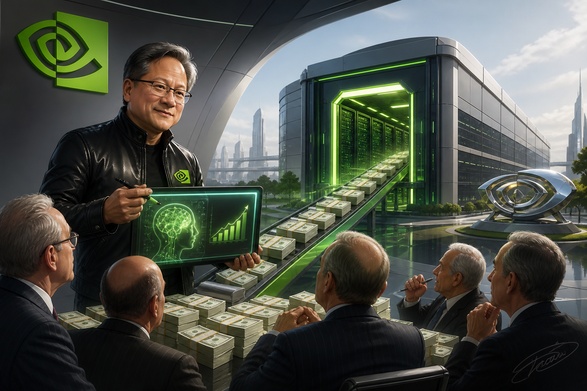
| tl;dr | A Yahoo Finance news article reports Nvidia is working with major financial firms and banks to raise up to $500bn to fund AI infrastructure—especially large-scale data centers and power/compute buildouts. The piece cites Nvidia CEO Jensen Huang and names partners/investors such as BlackRock, Microsoft, and others, framing the effort as meeting surging demand for AI computing and energy. It emphasizes the scale of capital needed, the strategic importance of “AI factories,” and potential economic productivity gains, with limited discussion of risks or constraints. | ||||
| deeper: | The reporting is mostly straightforward and attribution-heavy (named companies, executive quotes, and a clear description of the funding goal). Bias shows up as a mildly boosterish framing: it largely accepts industry narratives about AI infrastructure necessity and economic benefits, while giving less space to counterpoints like grid constraints, environmental impacts, demand uncertainty, or financial risk. Quality is solid for a business brief, but it leans on corporate statements and big numbers without much independent validation or detailed deal structure (e.g., terms, timelines, binding commitments). | ||||
media: | |||||
| gen: 2026/08/04:14:52 in 3 min 43.3 sec (old)bias: 6 (Center) |
| type: lolsquality: 62 |
| pts: 0 |

 | author: | JJ Tan | institution: | Yahoo Finance | ¿porque no los dos? |
| tl;dr | A Yahoo Finance article argues Korean equities (KOSPI) could rise sharply, citing Goldman Sachs strategist Tim Moe’s “high conviction” view and a 12,000 KOSPI target implying major upside. It frames the case around valuation (forward P/E vs history), projected earnings growth, and Korea’s heavy semiconductor weight (SK Hynix, Samsung) benefiting from an AI-driven cycle. It also notes Korea-focused ETFs (e.g., EWY, FLKR, FKO) and recent market performance, suggesting Korea may be an accessible way for U.S. investors to express the AI theme. | ||||
| deeper: | The piece is materially pro-risk/pro-equity: it foregrounds a bullish call (“90% upside,” “high conviction”) and leans on a single prominent source (Goldman) with limited counterarguments or scenario analysis. It provides some concrete metrics (forward P/E, earnings growth estimates, ETF performance) but doesn’t clearly unpack assumptions, time horizon, risks (FX, geopolitics, export sensitivity), or what would falsify the thesis. Presentation appears somewhat click-driven (teaser language and multiple prompts/ads), reducing perceived rigor. | ||||
media: | |||||
| gen: 2026/07/25:14:15 in 53.3 sec (old)bias: 4 (Center) |
| type: newsquality: 72 |
| pts: 0 |

 | author: | Unknown | institution: | Yahoo Finance | ¿porque no los dos? |
| tl;dr | The piece argues that rapid growth in U.S. data centers (driven by cloud computing and especially AI) is a major, underappreciated driver of rising electricity demand and grid strain—more so than geopolitical events like Iran-related oil shocks. It suggests the “energy crisis” is being built domestically through load growth, slow grid build-out, and lagging generation/transmission additions, and it warns consumers may face higher power prices and reliability risks if infrastructure and policy don’t keep pace. | ||||
| deeper: | The headline is provocative (“Not Iran”) and frames the issue as a corrective to a popular narrative, which adds some rhetorical bias. The argument itself is broadly plausible and consistent with current load-growth discussions (AI/data centers, grid congestion, permitting delays), but the screenshot doesn’t show strong quantification transparency, clear sourcing hierarchy, or robust counterarguments (e.g., regional variation, efficiency gains, planned capacity, demand response). Overall: solid explanatory take with some sensational framing. | ||||
media: | |||||
| gen: 2026/07/06:00:47 in 1 min 35.3 sec (old)bias: 2 (Center) |
| type: lolsquality: 85 |
| pts: 0 |
 | author: | Daniel Sparks, The Motley Fool | institution: | Yahoo Finance | ¿porque no los dos? |
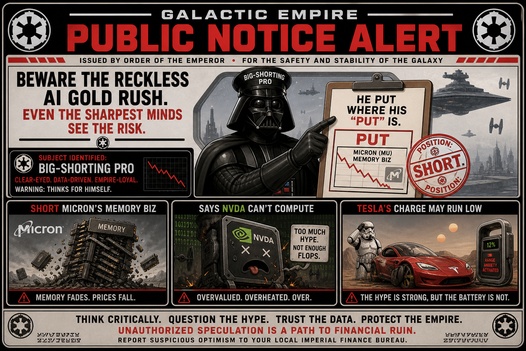
| tl;dr | The article discusses Michael Burry's decision to bet against major tech companies like Micron, Nvidia, and Tesla due to perceived weaknesses in their stock evaluations and historical patterns. Burry is known for his successful bet against the housing market before the 2008 financial crisis, adding weight to his current predictions. The piece examines Burry's reasoning, highlighting his focus on market cycles and valuations. | ||||
| deeper: | The article provides a balanced overview of Burry's investment strategy without overt bias. It relies on historical data and evaluations of market patterns to explain his rationale, offering a well-rounded perspective. The quality of analysis is high, making it informative and compelling for readers interested in financial markets. | ||||
| gen: 2025/05/20:02:30 in 1 min 12.3 sec (old)bias: 3 (Center) |
| type: lolsquality: 85 |
| pts: 0 |

 | author: | Unknown | institution: | Yahoo Finance | ¿porque no los dos? |
| tl;dr | The graph shows that while the top marginal income tax rate in the U.S. has generally decreased over the past 75 years, the national debt has significantly increased. | ||||
| deeper: | The image presents factual data without apparent bias, as it relies on historical tax rates and debt information. The potential bias may stem from the implied correlation between tax rates and national debt without further analysis. The quality is high due to clear visuals and credible sources. | ||||
media: No Media Preview | |||||
| gen: 2025/04/29:01:19 in 58.7 sec (old)bias: 5 (Center) |
| type: lolsquality: 75 |
| pts: 0 |

 | author: | Kevin Ryan | institution: | Yahoo Finance | ¿porque no los dos? |
| tl;dr | An economist from Apollo Global Management predicts a voluntary recession due to tariffs and trade restrictions. The reduction of imports, especially from China, is expected to lead to supply chain disruptions, empty shelves, and a full-blown recession by summer. | ||||
| deeper: | The article presents a straightforward analysis based on an economist's predictions and the economic impacts of tariffs. It maintains a neutral tone but heavily relies on a single expert's perspective, which could introduce some bias. More viewpoints or counterarguments could enhance depth. The quality is solid but could be improved with additional expert commentary or more recent data. | ||||
media: | |||||
| gen: 2024/06/07:04:42 in 19.9 sec (old)bias: 3 (Center) |
| type: newsquality: 70 |
| pts: 0 |

 | author: | Daniel Howley - Technology Editor | institution: | Yahoo Finance | ¿porque no los dos? |
| tl;dr | The article discusses Nvidia's stock performance following a brief surge that saw the company surpass a $3 trillion market cap. Despite the pullback, the stock remains highly valuable, marking Nvidia as one of the most valuable companies on the US stock market. The article details Nvidia's recent financials, key product announcements, and competitive dynamics with peers such as AMD and Intel. It also touches upon broader economic conditions, including potential Federal Reserve interest rate cuts, and other tech industry dynamics. | ||||
| deeper: | The article provides a factual account of Nvidia's stock performance and business announcements with minimal bias. It includes specific financial figures, quotes from Nvidia's leadership, and context regarding the broader tech industry and economic conditions. However, the presence of advertisements and recommended stories, which could influence readers' perceptions and engagement with the content, slightly detracts from the quality score. Additionally, the article draws a direct comparison between Nvidia and other tech giants such as Amazon and Google, maintaining objectivity overall but hinting at a pro-business lean. | ||||
media: | |||||
You made it to the bottom. Now dance!


owned and operated by: RPN Omnigalactic Insitutution as of: 2026/10/15: 10:57 in 0 ms
Enter Code
Login with Account